
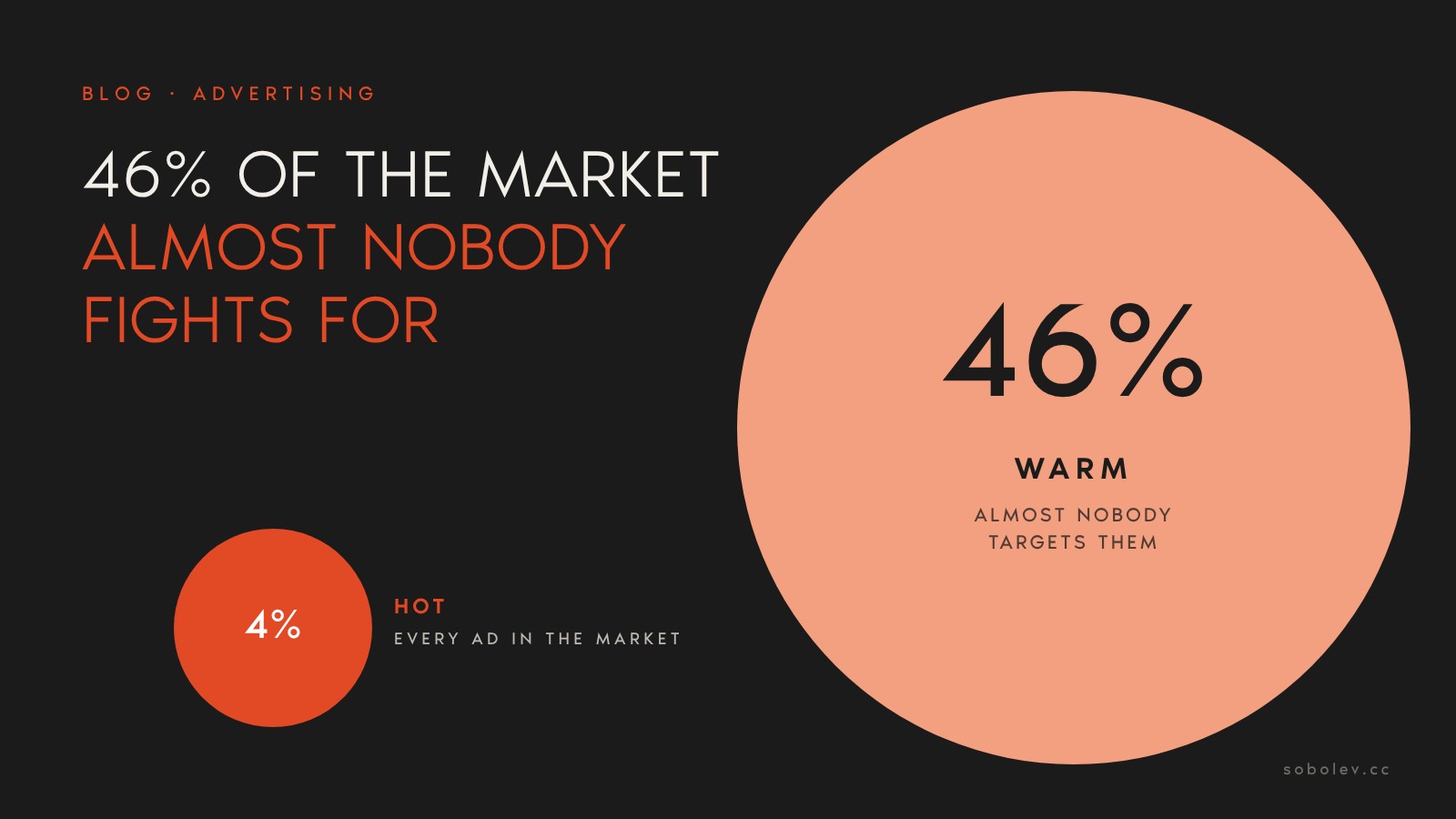
In short: your settings aren’t the issue. Almost every ad in your market, yours and your competitors’, targets the same 4% of hot buyers. They are the most expensive customers there are, because everyone is bidding for them. Next to them sit 46% of warm people. They already have the problem but aren’t looking for a solution yet, and almost nobody works with them. You reach them with the same advertising, used differently. Impressions are cheaper, and your ad actually gets seen.
What every market is made of
Every market splits into three parts. The rule holds for a dental clinic, an accounting firm and a property developer alike.
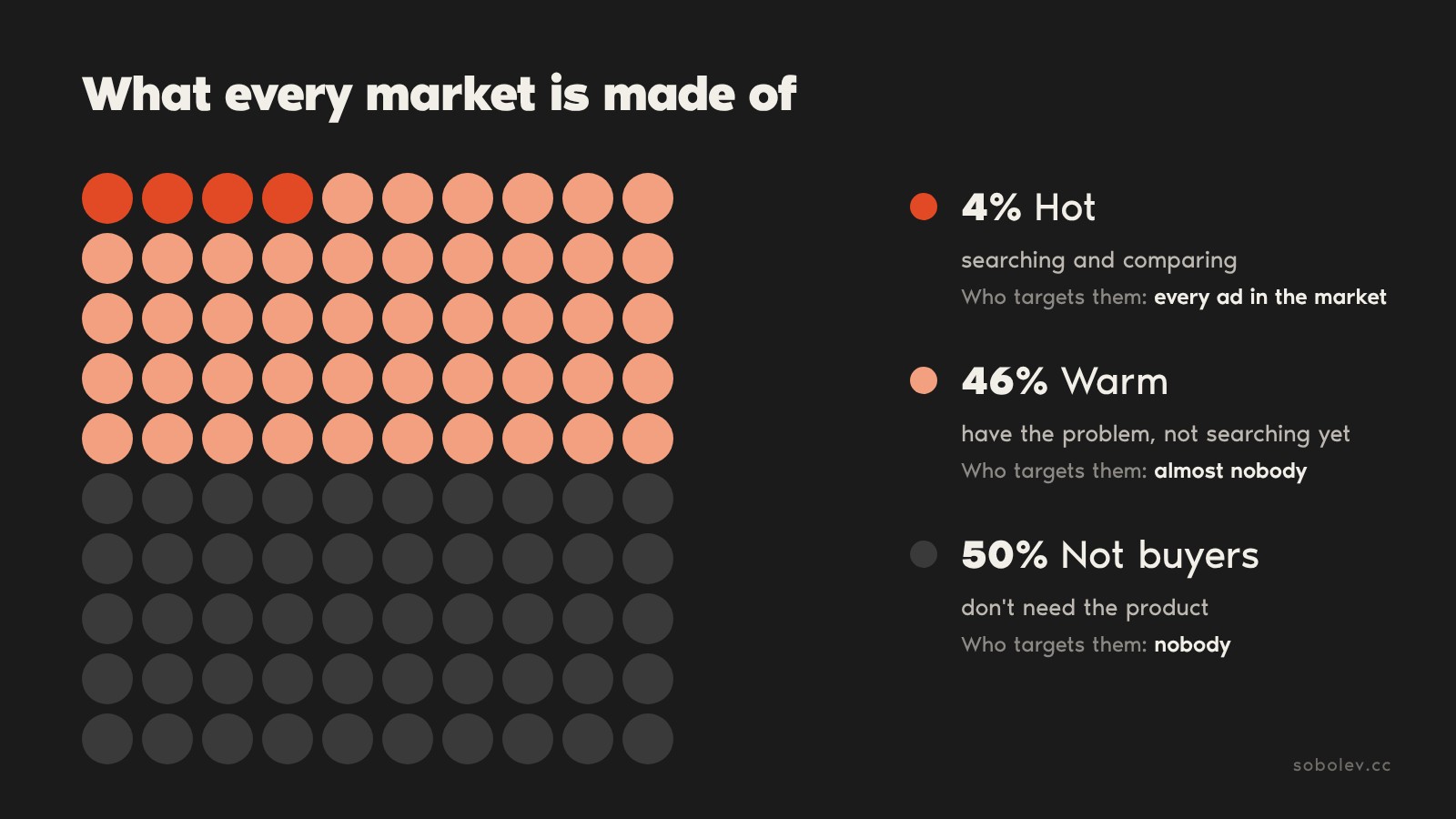
| Segment | Share | Who they are | Who targets them |
|---|---|---|---|
| Hot | ~4% | Already searching, comparing offers, choosing | Every ad in the market |
| Warm | ~46% | Have the problem, not looking for a solution yet | Almost nobody |
| Not buyers | ~50% | No need, no money, or you’re not a fit | Nobody, and that’s fine |
A hot buyer types “buy a new-build apartment” into search. A warm person is only thinking that a studio flat feels tight with two kids and something has to change. In six months they’ll be hot. The only question is who will already be on their mind by then.
Why hot customers are the most expensive
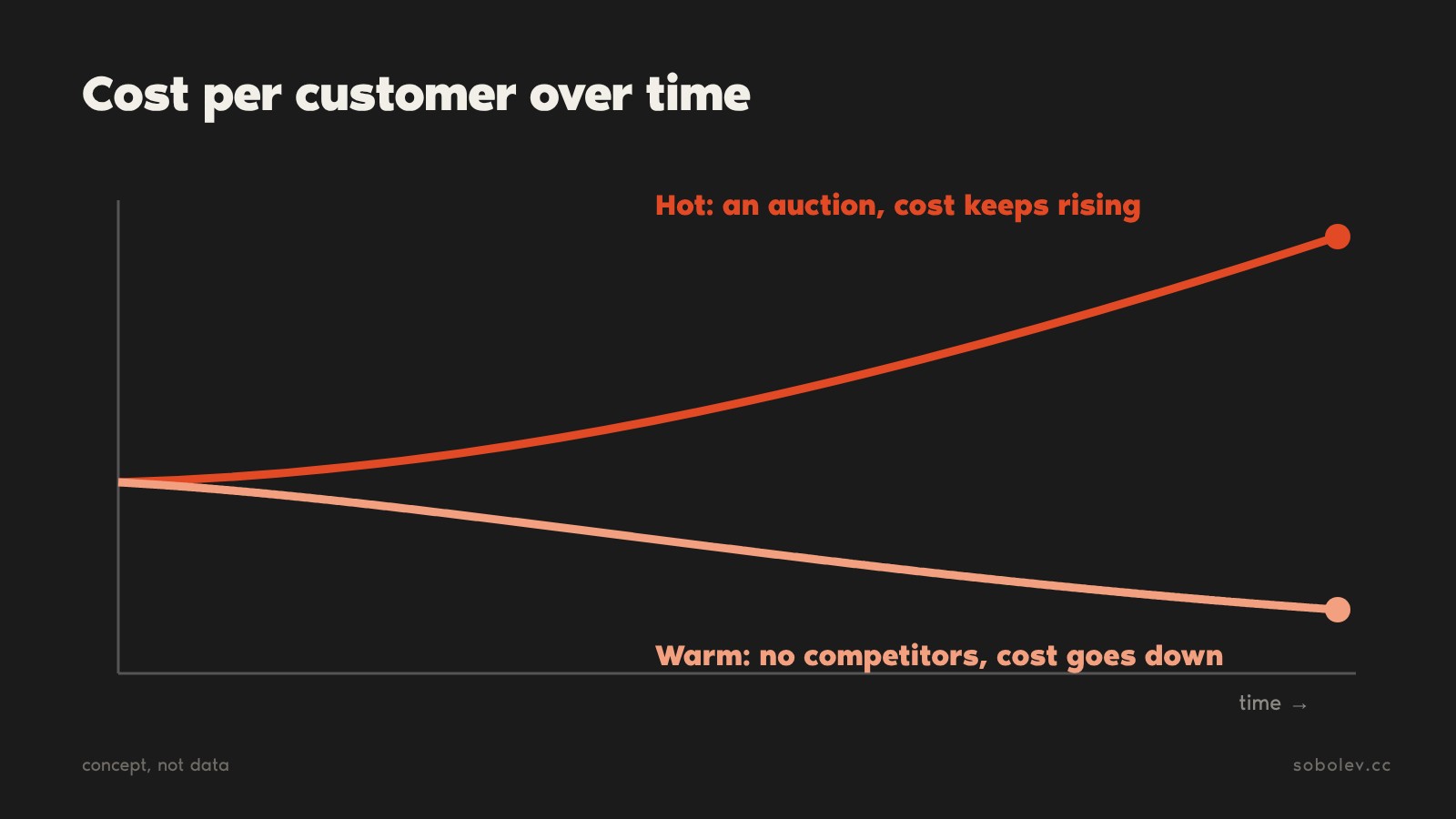
Advertising is an auction. Every company in your niche bids for the same impression in front of a hot buyer, and the price goes up every month. Any cost-per-lead optimisation here is temporary: a competitor raises the bid and you’re paying more again.
The auction goes to whoever can afford to pay the most per customer: a higher average order, a longer customer lifetime, a tighter sales process. Everyone else fights over what’s left and slides into the red.
A hot buyer drowns in identical ads
The second problem with hot buyers matters even more than price. Take someone looking for an apartment. The moment they start searching, hundreds of developers chase them. Every feed shows new residences, mortgages from 6%, instalment plans and free parking. Within a week they can’t tell one from another, so they pick on price or simply tune out.
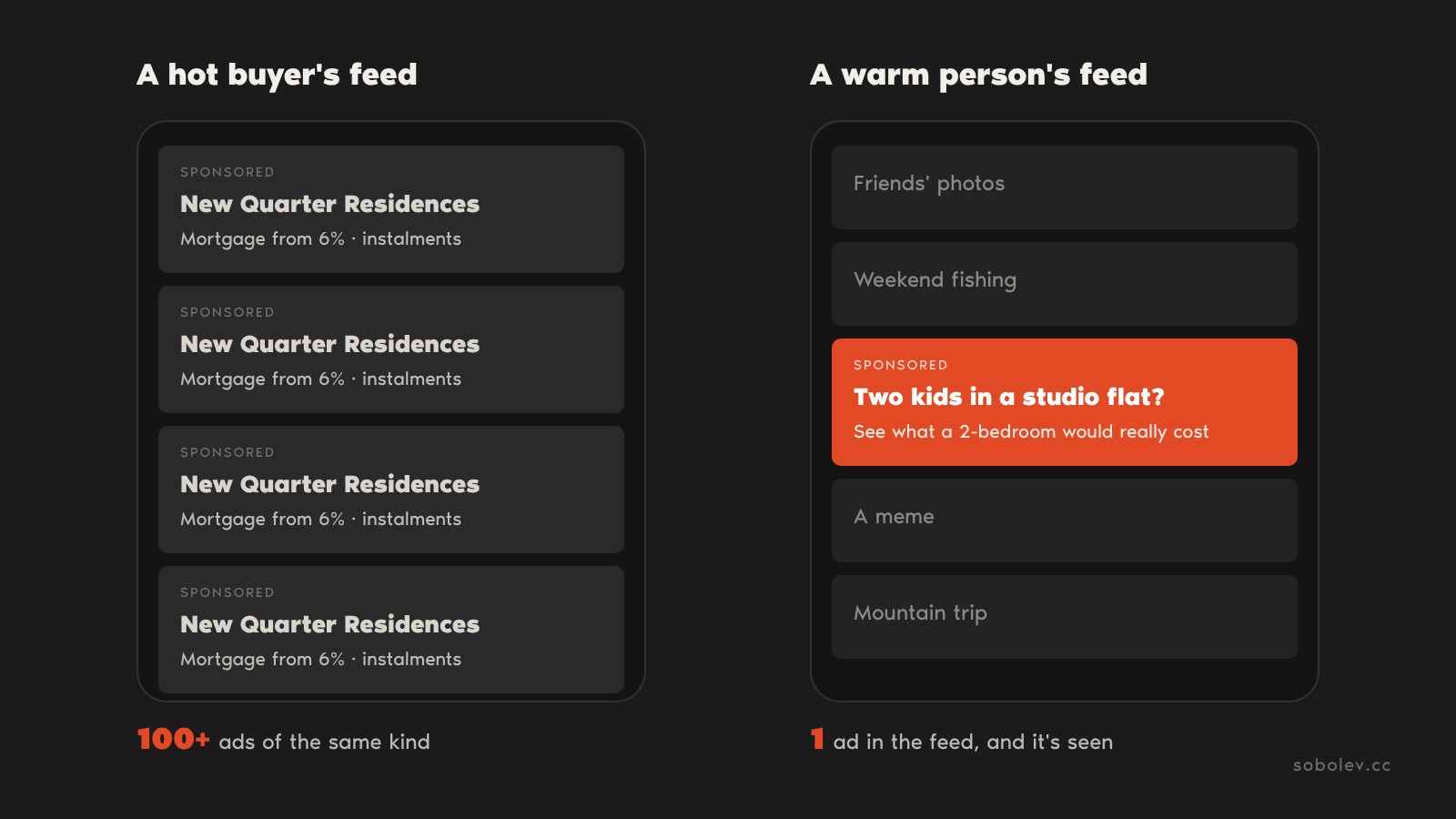
Now the same developer shows an ad to a warm person who isn’t thinking about apartments yet. Their feed is friends’ photos, fishing trips, memes and holidays. The developer’s ad is the only one there, and it stands out right away. Even more so when it speaks to their situation: “Two kids in a studio flat? See what a 2-bedroom would really cost on a mortgage.”
Search works the same way. Everyone has bought up “build a house near the city”, and a click costs as much as dinner out. Nobody bids on “best place to live in retirement”, yet that query lets you plant an idea and walk the person towards “a house of my own is the best option”.
Why warm customers cost less and bring more
Three reasons:
- No auction. Almost nobody is bidding for a warm person, so impressions and clicks are cheaper.
- You get noticed. Your ad is the only one in the feed. People see it and remember it.
- You get there first. While competitors wait for the person to start searching, you’ve already helped them make sense of their situation. When the problem ripens, they go to whoever is already on their mind. That’s you.
An honest caveat: a warm person doesn’t buy tomorrow. The first leads take a few weeks. So warm ads don’t replace hot ones if you have the budget for both. They give you a second stream of customers that gets cheaper than the first over time.
How to lead a warm customer to a purchase
Showing a discount to a warm person is pointless. A discount on something they don’t need yet doesn’t work. You need to walk them up a ladder: from “I have a problem” to “I want to fix it, and I’ll do it with you”.
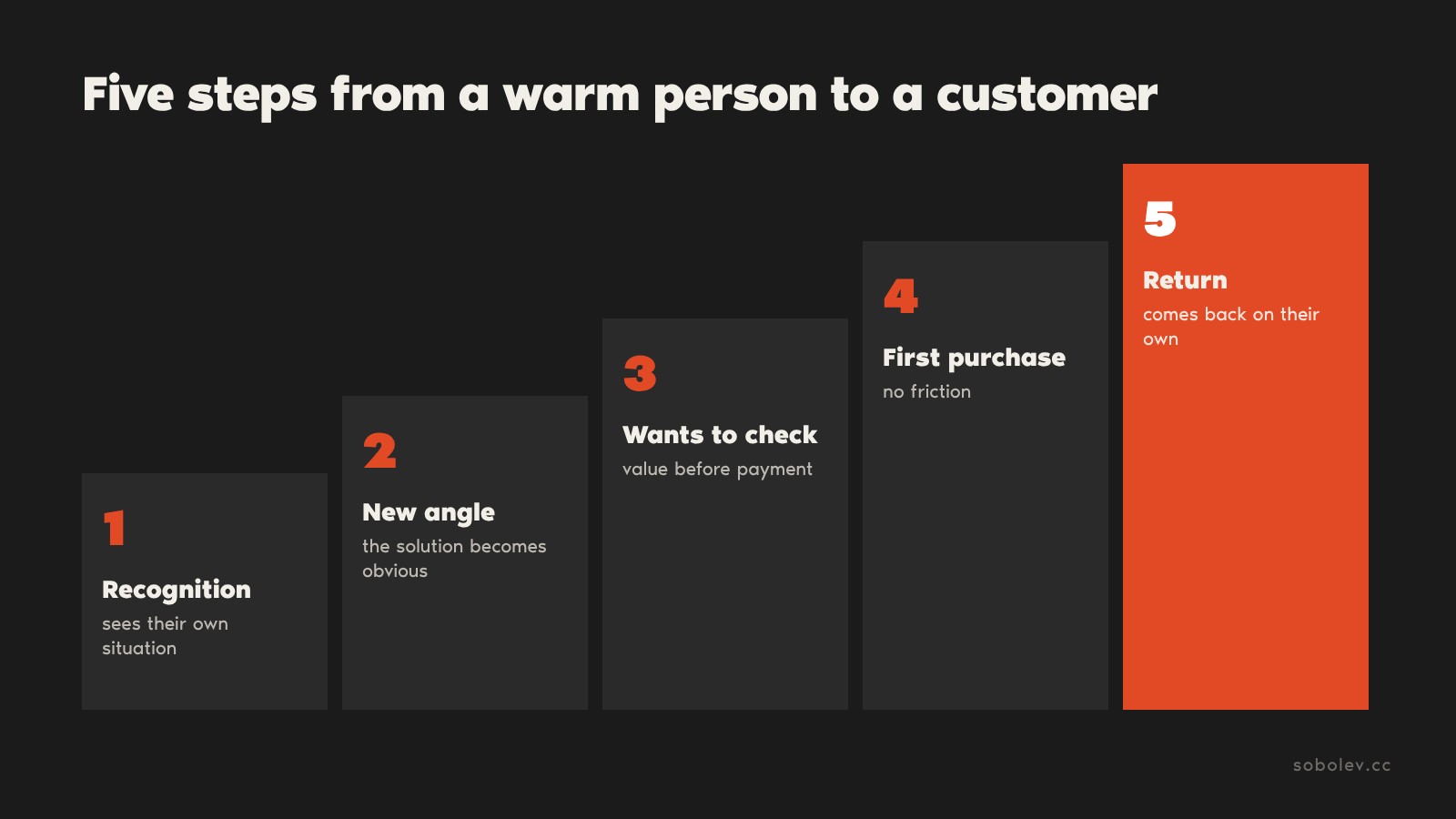
- Recognition. The person sees their own situation in the ad. The product stays in the background. “My teeth don’t hurt, and I haven’t seen a dentist in three years.”
- New angle. You describe their situation so the solution becomes obvious. “A cleaning every six months costs less than one filling.”
- Wants to check. “I should” turns into “I want to look into it”. This is where something useful and free works: a calculator, a checklist, a breakdown.
- First purchase with no friction. A clear price, booking in two taps, no “call us for details”. This is the step where most people drop off.
- Return. A reminder, the next step, good service. A customer who comes back on their own doesn’t depend on the auction at all.
At every step you win by explaining. Price barely matters here.
Where to find warm people: ad formats
You reach warm people with the same advertising, just used differently: the audience changes, so does the message, and so does what you offer after the click.
Target the situation. Ad platforms now pick the audience themselves, based on who reacts to the creative. So the creative is the targeting. An ad about a situation (“two kids in a studio flat”, “third month losing money on ads”) will be shown by the platform to people who are in that situation.
Search ads on neighbouring queries. “How to choose a neighbourhood for a family”, “how much does moving cost”, “mortgage or renting”. These queries have far fewer competitors, and the people are the same, just six months earlier.
Advertise a useful step. A calculator, a guide, a checklist, a short breakdown. The person gets value right away, and you get their contact and the right to write to them again.
Retarget people who’ve already seen you. A warm person rarely buys on the first touch. They watched a video, opened a calculator but didn’t leave a request: show the next step to that audience. It’s the cheapest advertising of all, because they already know you.
Your own customer base. Competitors can’t see everyone who once left you a contact and didn’t buy. A useful email or message with a soft next step costs next to nothing, and people from your base buy more often than people from cold ads.
Comparison: hot vs warm advertising
| Parameter | Ads for hot buyers | Ads for warm people |
|---|---|---|
| Competition | The whole niche in one auction | Almost empty |
| Cost per customer | The highest, and rising | Lower, and falling over time |
| Ad visibility | One of dozens of identical ads | The only one in the feed |
| Speed of first leads | Days | A few weeks |
| If you switch it off | Leads stop | Your base and recognition stay |
FAQ
So should I switch off ads for hot buyers?
No. If your economics allow it, hot buyers bring fast sales. The problem is living on them alone. Warm advertising gives you a second, cheaper stream and makes you less dependent on the auction.
Why don’t my ads pay off with a decent budget?
Because a budget alone doesn’t win the auction for hot buyers. If a competitor has a higher average order or converts leads into sales better, they’ll pay more per customer than you can. There are two ways out: fix your economics, or go where there’s no auction.
Does this work in B2B?
Yes, even better. B2B decisions take longer, there are more warm people, and almost no ads explain their situation in plain words. Breakdowns, calculators and templates for a narrow niche gather a warm audience faster than direct advertising.
How long until I see results?
The first leads from warm advertising usually arrive in 3–6 weeks. After that the stream grows: people you started leading earlier ripen and come on their own.