
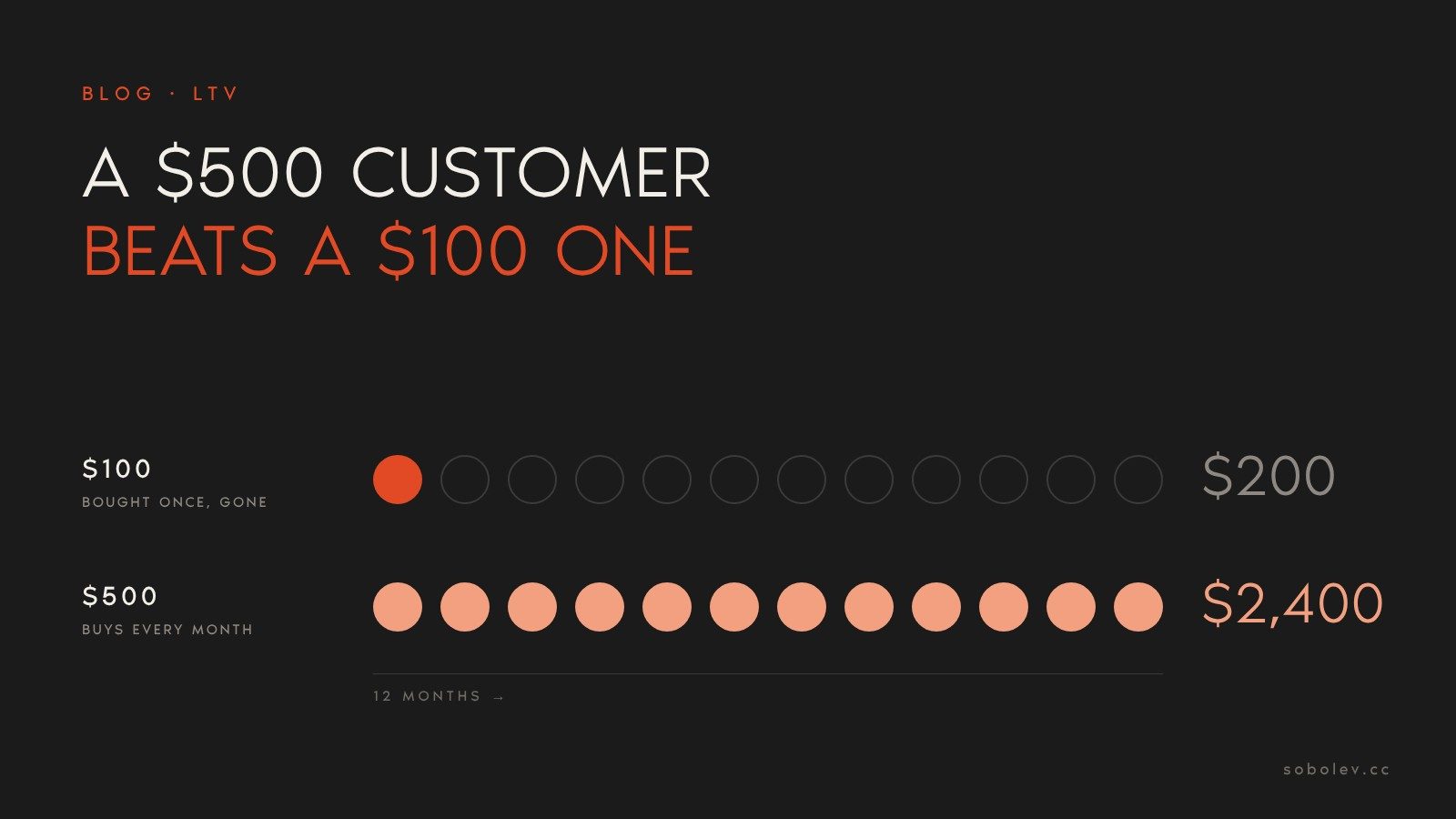
In short: to earn twice as much, you don’t need twice as many customers. You need the ones you already have to buy more often and spend more each time. That’s what LTV is for: how much money a customer brings you over a year. Once you know that number, everything changes. You stop trying to pay back a customer on the first sale, you can afford to bid higher than competitors, and the business becomes predictable.
Why chasing new customers leads to a dead end
Almost every business owner I talk to about growth thinks the same way. Customers bring money. Right now I have X customers. I want to earn twice as much, so I need 2X customers. The logic feels obvious, and it’s wrong.
The first problem: if you live on new customers alone, sooner or later you burn out your market. It doesn’t matter what you sell or where. Year after year you keep hitting the same people, and at some point everyone already knows you. There’s nobody new left to bring in.
Look at what happened to online courses. People were pumped up with “this course will change your life” and sold on credit for crazy money. They finished the course, didn’t get what was promised and felt cheated. Then the author came back with a new course, and nobody believed him anymore. Nobody thought about the second or third sale, the goal was to cash in right now. The audience burned out, and the courses stopped selling.
A regular business goes the same way, just slower. Almost every business, apart from rare cases like building a house or a wedding, lives on customers buying more than once. If you plan to earn from a person only once, you’re running an info-product scheme.
LTV: how much a customer brings you over a year
LTV (lifetime value) shows how much you earn from one customer over a set period. A year, two years, or the whole time they stay with you.
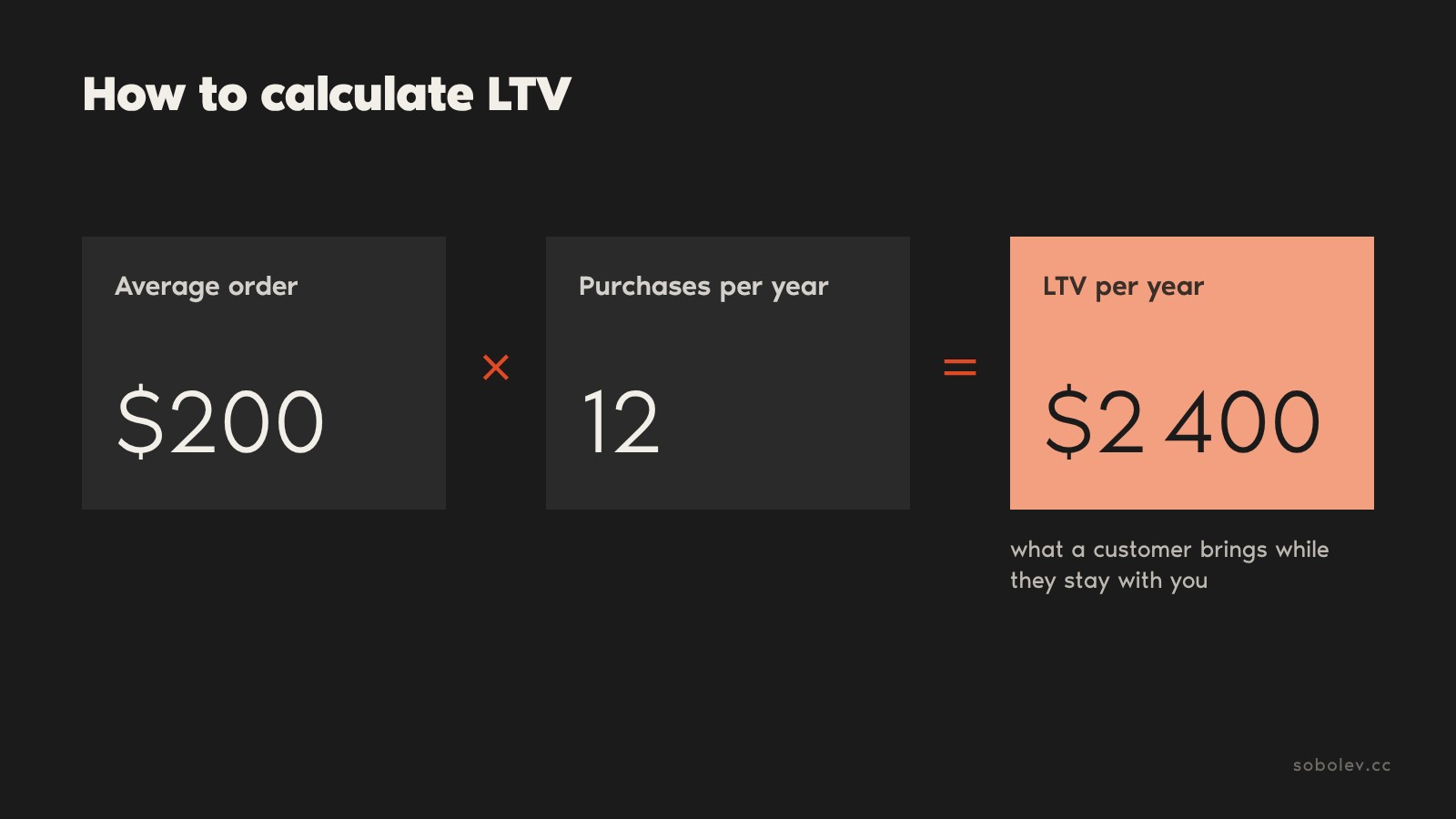
The math is simple: average order × how many times the customer buys in the period. A customer who spends $200 with you once a month brings in $2,400 a year. One purchase and a year with you differ twelvefold, and your ad decisions should be based on the second number.
Why bother counting? Because of a law I keep repeating: advertising always gets more expensive. Today your numbers still roughly add up. Tomorrow they won’t. The day after it’s a disaster, and then debt. You have to think a year, two, five years ahead. A quick fix only patches today’s hole, and the problem comes back tomorrow.
A $500 customer can be worth more than a $100 one
Most businesses expect a customer to pay off on the first sale. The logic goes: we spent $100 on ads, the customer has to bring at least $200, then we’ve made something.
Tell that owner you’ll bring him a customer for $300 or $500. He’ll say: “Are you out of your mind? I make $200 per customer and you want me to pay $500 for one?” In his picture of the world that’s fair. In the real economics of his business, he’s wrong.
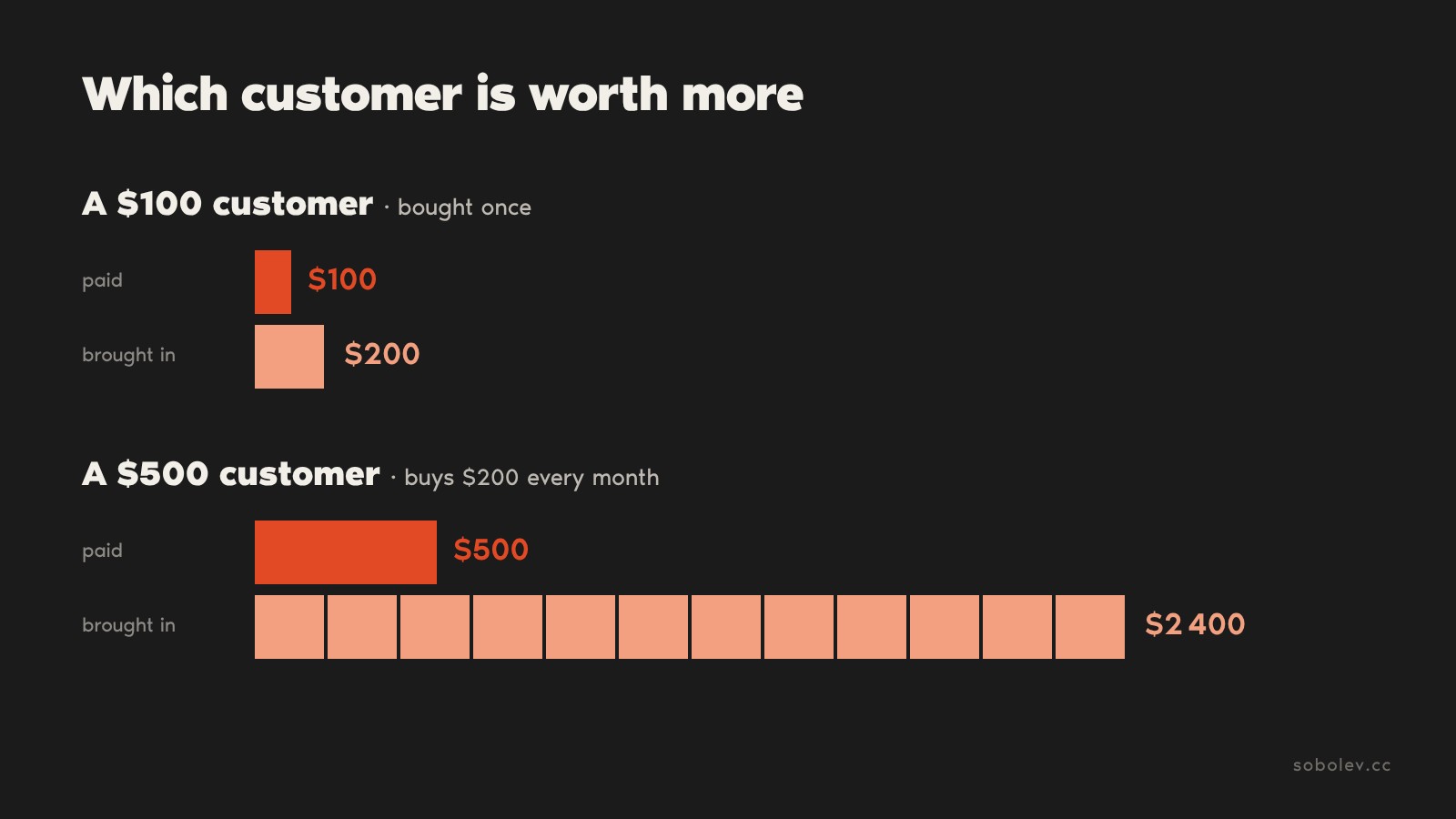
Take a customer who buys $200 worth once a month. You brought them in for $500. Over a year they bring $2,400. You paid for them once, and bringing them back costs next to nothing: an email, a call, a reminder. That spend is nowhere near the $500 you paid. Such a customer is worth more than one you got for $100 who bought once and never came back.
Which leads to the second point. If you know your LTV, you can pay more per customer than anyone in the market and still stay in profit. Why the ad auction goes to whoever can afford to pay the most, I covered in detail in my article about warm customers and an overheated market.
Look at big business and at Western markets. They’ve worked this way for years. A service acquires a customer and may not earn anything on them for a year: in year one it spends more on the customer than the customer pays. Profit starts in year two. Add discounts and perks for newcomers on top. Big business has long lived on recurring payments, and marketing there has one job: make the customer feel like they’ve subscribed to your product or service.
Ads get pricier while a leaky bucket eats your budget
The fight for customers right now is brutal. Ads keep getting more expensive, people trust them less, influencers cost a fortune. Getting new customers is harder every month. And almost nobody holds on to the old ones.
Many businesses have a colander where a funnel should be. People came in, 10% stayed. More came in, again 10% stayed. You can pour in more and spend more, it all drains out anyway. Fewer customers means even more money into ads.
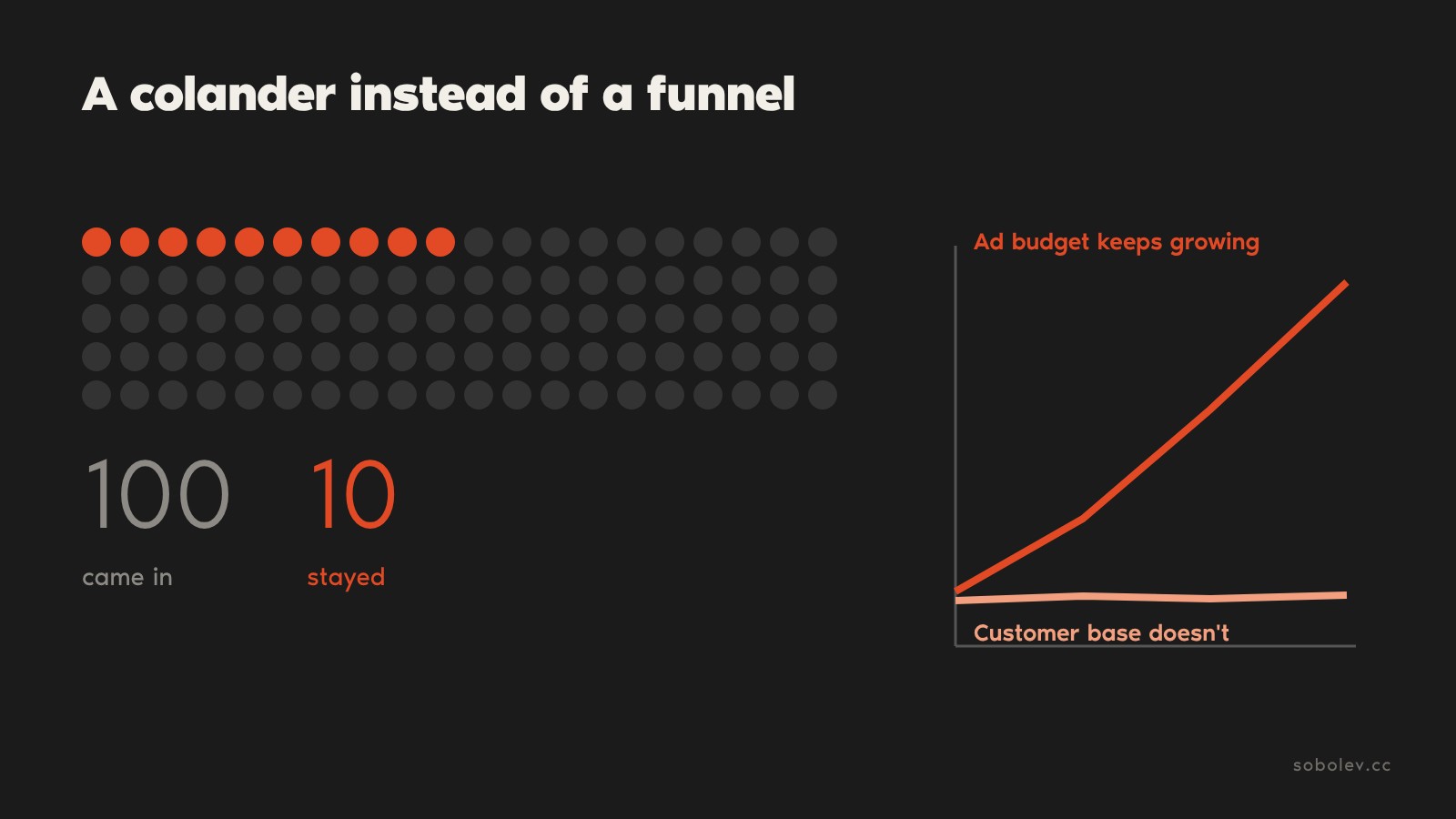
Now picture a competitor who brings in the same number of people, except his stay for a year. After a while he barely spends on ads and stays stable. You’ll lose that race even if your ads are better.
Stability is priceless for a business. Every owner wants to stop wondering each month whether there’ll be money for salaries. With a high LTV you can forecast: you know what your base will bring next month before you’ve launched a single ad.
How to double revenue without doubling customers
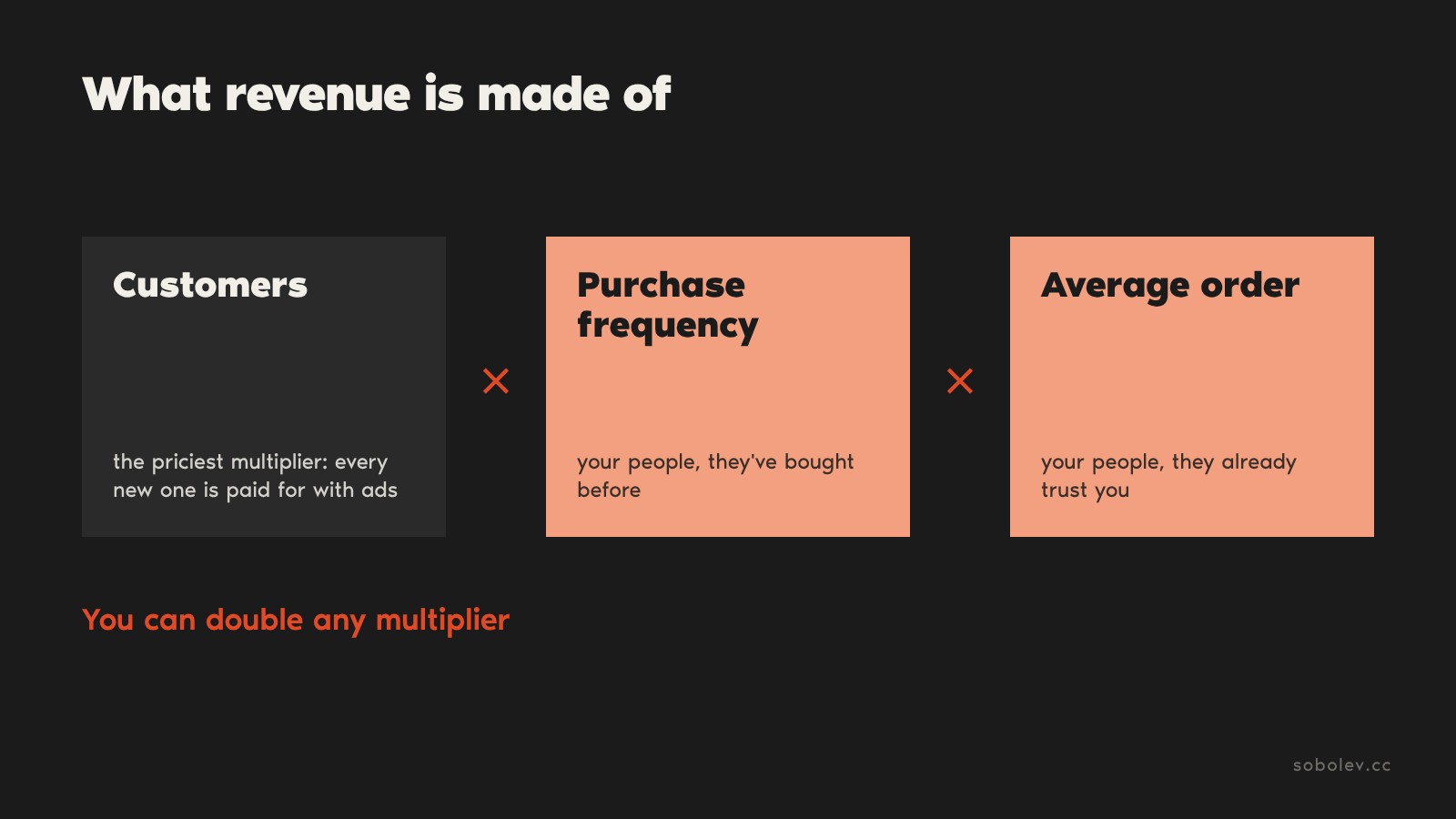
Back to where we started. Someone tells me: “I want to double my revenue.” I ask: why do you need twice as many new customers? Get the current ones to buy more. Once a week instead of once a month. With a bigger order. You still need new customers, just not as many, and you need less money for ads.
Where to start:
- Calculate your LTV. Average order, how many times a customer buys per year, how many leave after the first purchase. Without these numbers you’re running the business blind.
- Build your customer base. Phone, name, visit date, what they bought. Most businesses already have this in their POS or CRM, but almost nobody works with it.
- Deliver quality people want to come back to. The better the product and service, the more likely a person returns. Marketing can’t rescue something people walk away from.
- Remind them you exist. Emails, a call, a message at the right moment. It costs pennies compared to acquiring a new customer.
- Upsell. The person has already agreed to pay you, so offer them something else with the purchase.
FAQ
What is LTV in simple terms?
How much money one customer brings you over a set period, usually a year. It’s the average order multiplied by the number of purchases in that period.
So I don’t need new customers?
You do. But if your base doesn’t stick, new customers just pass straight through. Plug the holes first, then pour in traffic: every new customer will start bringing several times more.
How much can I pay to acquire a customer?
As much as your LTV allows. The first purchase is a poor guide here. If a customer brings $2,400 a year, getting them for $500 pays off, even if the first purchase is only $200.
What if customers only buy from me once?
There are fewer such businesses than it seems. Even where the main purchase is one-off, you can sell add-ons or service, or get new customers through referrals. Think about what else a person needs after the first purchase.
The money is already in your customers, you just aren’t counting it. If you want to go through your own base and see how much money is in it, message me on Telegram.